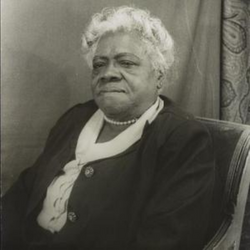
Mary McLeod Bethune was born on July 10, 1875, in Mayesville, South Carolina. She was number 15 of 17 children and received an unusual opportunity to attend school to obtain an education not commonly given to African Americans in the Reconstruction years of the south. Much of her formal training was in preparation to do mission work abroad, however, she was never able to practice her formal training. As an adult, she did become a teacher and was able to teach at schools in Georgia and South Carolina.
In South Carolina, she met her husband, Albertus Bethune, and a year after her son Albert was born, the family moved to Florida. In Florida, she was able to continue teaching and established a missionary school as well as the Daytona Normal and Industrial Institute for Negro Girls. As the student population continued to grow, in 1931, the schools merged and became accredited by the Association of Colleges and Secondary Schools of the Southern States, with its name officially changed now to Bethune-Cookman University in Daytona Beach, Florida. Bethune became the first African American woman to serve as a college president.
Bethune was able to use her platform to establish programs that would combat poverty, segregated schools and would help improve healthcare for Black women and children. Her efforts helped to gain her recognition and she became the president of the National Association of Colored Women (NACW) in 1924. Her prominence soon drew attention from U.S. Presidents, and Bethune went on to serve as an advisor on labor, education, and youth employment to Presidents Calvin Coolidge and Herbert Hoover.
In 1935, President Franklin D. Roosevelt asked Bethune to serve as a Special Advisor to the National Youth Administration, where he later created a department specifically for her within the agency as the Director of Negro Affairs as the first African American woman to head a federal agency. The efforts made by this cabinet later would ultimately create the political foundation of what would become the modern civil rights movement.
During World War II, Bethune was active in aiding support for the war effort among African Americans and women in the war efforts. After the war, she continued to serve as an associate consultant to the U.S. delegation to help draft the United Nations charter where she continued to advocate for better treatment of people living in the United States and other colonized countries. Her efforts continued until her death in May 1955. She was the first Black woman to have a national monument dedicated to her in the nation’s capital. Today, there are several streets, parks, and schools all named in her honor. Despite the many challenges Bethune faced throughout her life, her passion and determination helped her to better advance her community and other marginalized groups. We admire this trailblazing woman that inspired so many other women who came after her.
References:
Mary McLeod Bethune Council House
How did you celebrate this black month? Let us know in the comments below.